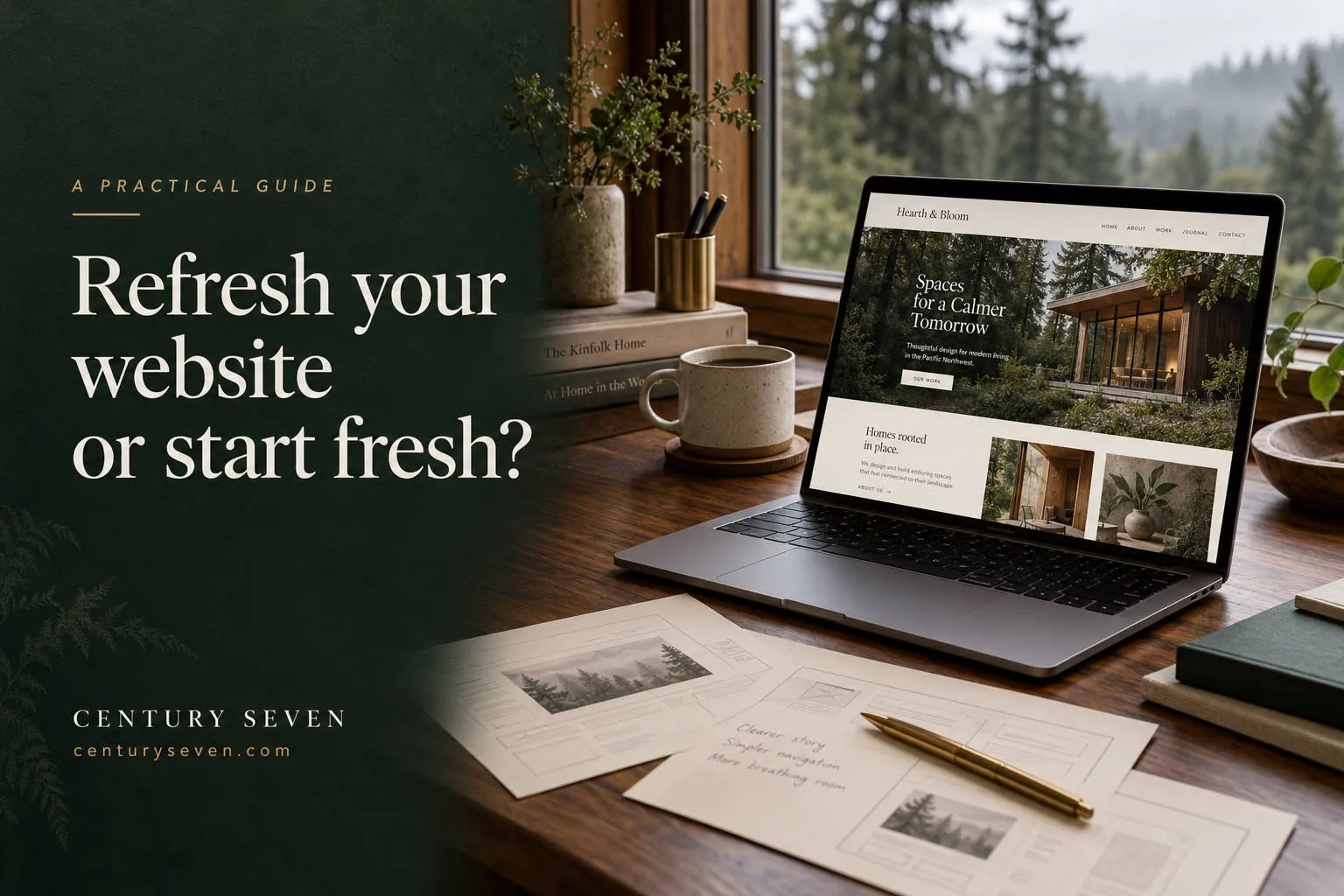
Your business has grown. Your services have evolved, you have new work to share, and you have a clearer understanding of the customers you serve best. Now you're wondering whether your website needs a few thoughtful improvements or a more comprehensive redesign.
It's a reasonable question, especially when your existing website still does some things well. You may like its overall appearance but find updating it frustrating. Or it may work reliably while giving visitors an incomplete picture of what your business offers today.
The best approach starts with understanding what's working, what needs attention, and what you want your website to help you accomplish.
What's the difference between a refresh and a redesign?
A website refresh improves an existing site while retaining most of its underlying structure. That could mean rewriting the homepage, updating photography, simplifying navigation, improving mobile layouts, or making contact information easier to find.
A redesign takes a broader look at how the website should function and communicate. It may involve reorganizing pages, developing a new visual direction, rebuilding templates, or changing the technology that supports the site.
There's plenty of room between those two approaches. A website might benefit from entirely new content and layouts while keeping its current platform. Another might need a technical rebuild while retaining familiar branding and much of its existing content.
The scope should follow the needs of the business.
When a website refresh makes sense
A refresh is often a good fit when your website has a dependable foundation and the improvements you need are relatively focused.
Your content needs to catch up with your business
Perhaps you've introduced a service, expanded your service area, or completed projects that better represent the work you do today. Your website's structure still makes sense, but its words and images need attention.
For example, a contractor might have a useful gallery and straightforward navigation, while the homepage still emphasizes services the company rarely provides. Updating that messaging and featuring more relevant projects could bring the site much closer to the business it represents.
Customers can find their way around
If visitors can locate your services, understand your offering, and contact you without difficulty, you may already have a useful structure to build on.
In that situation, targeted changes can improve the experience: clearer page introductions, more readable text, better button placement, or a shorter inquiry form.
Your branding needs a thoughtful update
New photography, refined typography, and more consistent colors can give an existing website a more cohesive appearance.
Those improvements work best when they support the content. A visitor should be able to understand your services as easily as they can appreciate the design.
Your website remains manageable
If you can make routine updates, your software is maintained, and the site can accommodate the changes you need, there may be good reasons to keep the existing system.
Before committing to a rebuild, it's worth assessing how much you can accomplish with what you already have.
When starting fresh makes sense
A more comprehensive redesign becomes useful when the challenges extend across the website or its foundation makes improvements difficult.
Your business has changed substantially
A company that once offered one service may now have several distinct areas of expertise. A business that served individual customers may have expanded into commercial work. An informational website may now need to support online sales or customer accounts.
When those changes affect what visitors need to know and do, the website may need a new structure.
Adding more pages to the existing navigation can only take you so far. A redesign gives you an opportunity to organize the experience around the business you operate today.
Customers struggle to complete basic tasks
Consider what someone needs to accomplish on your website. Can they find the right service? Understand where you work? Request an estimate? Complete a purchase on their phone?
When several of those tasks are difficult, individual fixes may leave the overall experience confusing. A broader review can help you address the relationships between content, navigation, page layouts, and forms.
Routine changes have become difficult
If a simple update regularly breaks a layout, requires an elaborate workaround, or depends on software that is no longer maintained, the underlying system deserves attention.
A technical assessment can help determine whether those problems are contained or widespread. Sometimes a repair is sufficient. In other cases, rebuilding provides a more practical foundation for future updates.
Your website no longer supports how you work
You may need appointment scheduling, an online store, a customer portal, or connections to other business systems.
Those requirements don't automatically mean replacing the entire website. They do justify evaluating whether the current platform can support them reliably and how much ongoing effort that would require.
Start with the problem you want to solve
Before choosing a refresh or a redesign, write down the specific concerns that prompted the conversation.
"The website feels dated" is a useful starting observation. Try to make it more concrete:
- Our recent work isn't represented.
- Visitors have trouble finding the right service.
- The inquiry form is difficult to use on a phone.
- Our team struggles to update the content.
- We need customers to book or purchase online.
Then describe what an improvement would look like. You might want better-qualified inquiries, fewer questions about basic service details, easier content updates, or a simpler purchasing process.
Clear goals make it easier to evaluate a proposal and determine whether the scope addresses your needs.
They also help distinguish website issues from other business challenges. If very few people visit your site, for example, a visual redesign alone won't explain how you plan to reach more potential customers.
Preserve what your current website does well
Even a substantial redesign should begin with a review of the existing site.
Useful service descriptions, recognizable branding, strong photography, and pages that bring relevant visitors may all deserve a place in the new version. Existing inquiries and customer feedback can also reveal which information people value.
Search visibility needs attention during this process. When page addresses change, relevant permanent redirects help visitors and search engines find the replacement pages. Google recommends planning the relationship between old and new URLs as part of a site migration.
A redesign is an opportunity to build on the value you already have.
Compare the full scope of each option
A smaller project can be the right investment when it resolves clearly defined problems. A larger project can make sense when several connected issues need attention.
Ask what each proposal includes: content, design, development, mobile usability, testing, launch support, and future maintenance. Also consider the time your team will need to spend gathering materials, reviewing work, and learning any new tools.
A refresh that resolves your main concerns may serve you well for years. A series of temporary fixes may become less practical if every change runs into the same underlying limitations.
The useful question is:
Which approach gives us a manageable website that supports the work we need it to do?
You can make improvements in stages
For some businesses, a phased approach is the most practical choice.
You might begin by clarifying your homepage, improving the contact experience, and updating your most important service pages. A broader redesign can follow when the content, budget, and business requirements are clearer.
That approach works best with a plan. Understanding the longer-term direction helps you choose improvements that will remain useful as the website evolves.
Choosing the right next step
You don't need to diagnose every technical issue before speaking with a developer. Bring your goals, the frustrations you've encountered, and examples of what customers need from your website.
A thoughtful review should help you understand what can be improved within the existing site, what would benefit from rebuilding, and why.
At Century Seven, we help businesses make those decisions with a clear understanding of their options. Whether your website needs a focused refresh or a fresh foundation, we'll help you shape it around your business, your customers, and the work ahead.
Considering changes to your website? Get in touch with Century Seven to talk through what you'd like to accomplish.